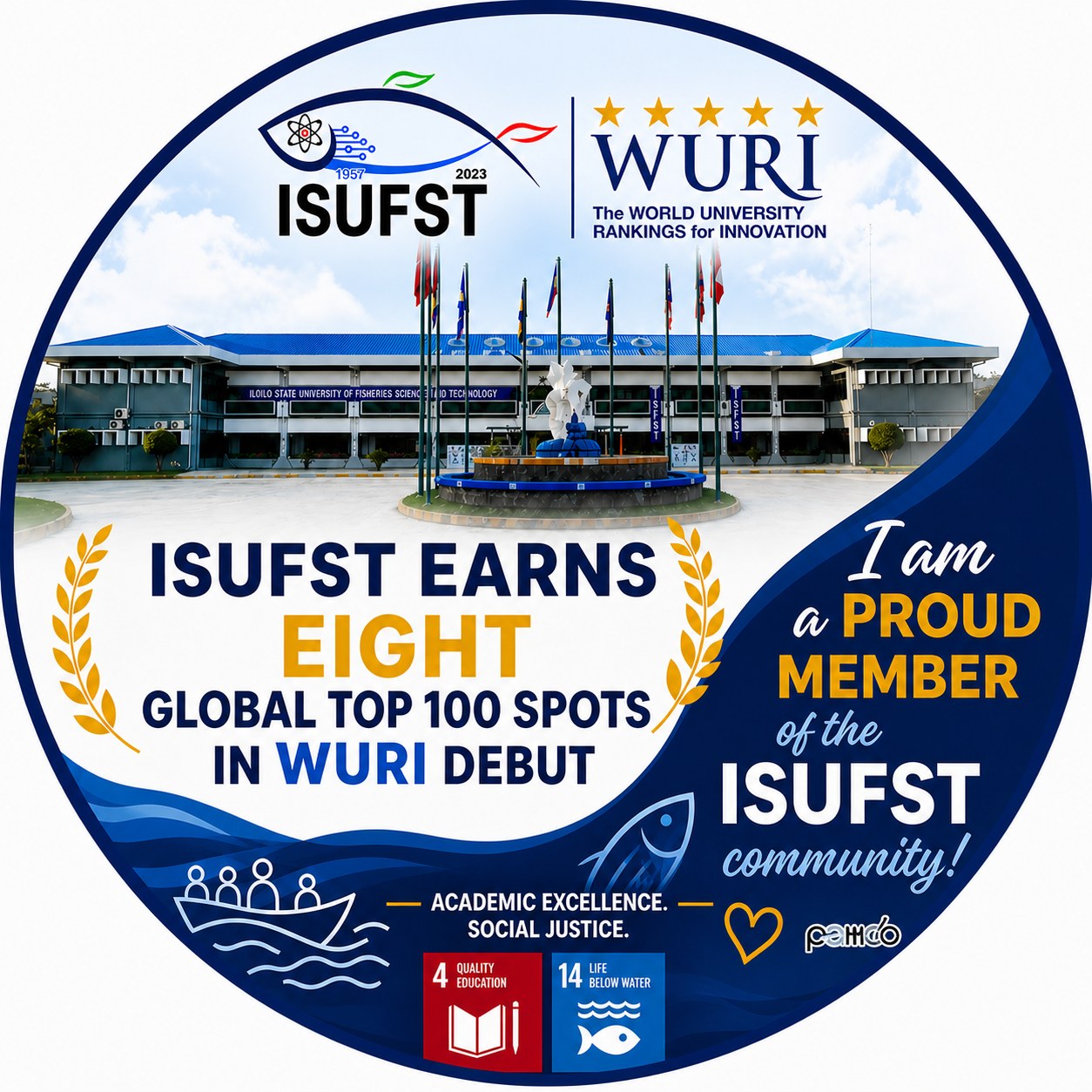
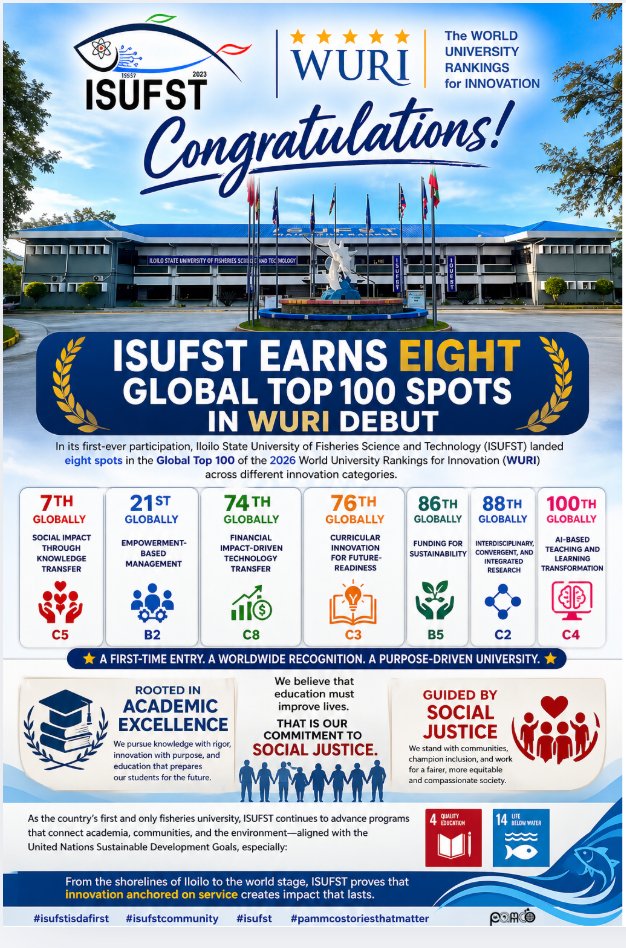
BAROTAC NUEVO, Iloilo—For a university joining the World University Rankings for Innovation (WURI) for the first time, Iloilo State University of Fisheries Science and Technology (ISUFST) made a quiet but meaningful entrance—landing eight spots in the Global Top 100 across different innovation categories.
The 2026 results placed ISUFST at 7th in Social Impact through Knowledge Transfer (C5), followed by 21st in Empowerment-Based Management (B2). It also ranked 74th in Financial Impact-Driven Technology Transfer (C8), 76th in Curricular Innovation for Future-Readiness (C3), 86th in Funding for Sustainability (B5), 88th in Interdisciplinary Research (C2), 93rd in Cost-Effectiveness Management (B7), and 100th in AI-Based Teaching and Learning Transformation (C4).
For those on campus, the recognition does not feel sudden or overwhelming. It feels familiar—like something that grew out of long, steady effort, much of it done quietly, without expecting anything in return.
University President Dr. Nordy D. Siason Jr. described the result as a reflection of what the institution has been trying to build over time. “This is really about staying true to what we believe education should do,” he said. “Academic excellence matters, but it has to translate into something that improves lives. That has always been part of how we see our role.”
He also pointed out that the recognition aligns with broader national directions in higher education. “Our efforts are closely tied to CHED’s ACHIEVE framework under Chairperson Dr. Shirley Agrupis,” Siason added. “What this shows is that when innovation is anchored on service and social justice, it resonates beyond our immediate setting.”
Unlike more traditional rankings, WURI looks less at reputation and more at how universities respond to real problems—whether their ideas can actually work, and whether they make a difference. Its process combines blind peer review, expert validation, and system-based analysis, putting emphasis on programs that are not only creative, but also practical and impactful.
That approach has attracted growing global participation. In recent cycles, thousands of innovation cases from over a thousand universities worldwide have been reviewed, creating a space where institutions are compared not just by what they produce, but by what they change.
For ISUFST, the WURI entry builds on earlier steps toward international visibility—from internal workshops on global rankings to participation in regional capacity-building efforts. These were not isolated activities, but part of a longer attempt to align teaching, research, and extension work with global standards while staying grounded in local realities.
Over the years, much of the university’s work has naturally fallen in step with the United Nations Sustainable Development Goals (SDGs). Whether it’s widening access to education, finding practical ways to innovate, working with partners, or caring for marine resources, these have never really been new directions—they’ve long been part of what ISUFST stands for as the country’s only fisheries university.
Founded in 1957, the university has grown across five campuses, with programs spanning fisheries, education, technology, and management. In recent years, it has also received multiple recognitions from CHED, particularly in extension, peace education, student services, internationalization, and inclusive education.
Dr. Siason says the WURI results are “less about arrival and more about direction.”
“The work is far from finished. Much remains to be done—systems to improve and communities to serve better. But this recognition holds a simple truth: institutions do not have to be at the center to matter, as long as their work reaches people in real ways.” (Herman Lagon | Rex Paulino | PAMMCO)
#isufstisdafirst #isufstcommunity #isufst #pammcostoriesthatmatter