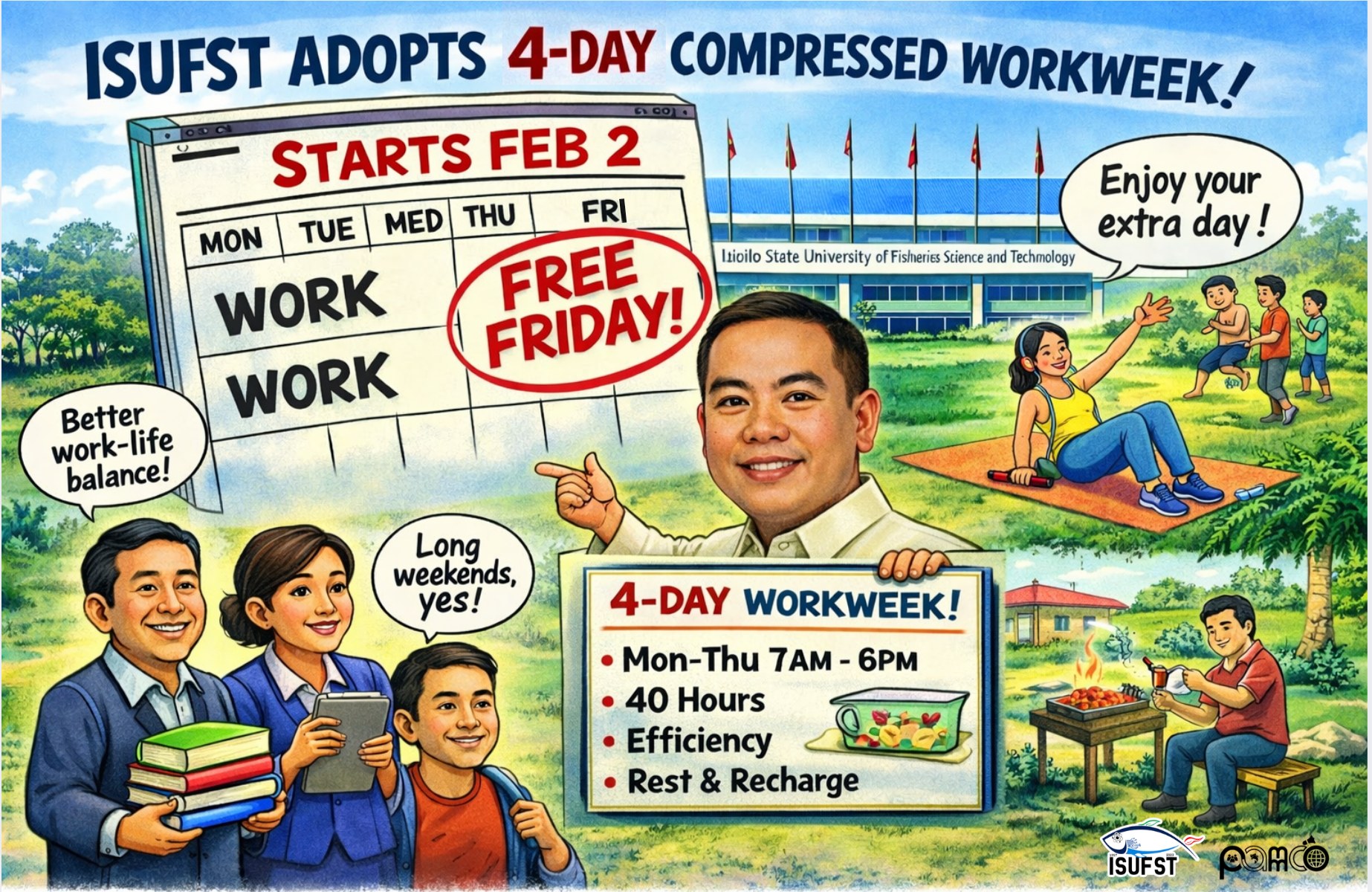
POLICY STARTS FEB 2. The Iloilo State University of Fisheries Science and Technology (ISUFST) has formally adopted a four-day compressed workweek (CWW) for the entire second semester of the Academic Year 2025-2026, becoming the first university in Western Visayas to implement the scheme under approved internal guidelines anchored on civil service regulations.
The innovative policy was proclaimed this Wednesday afternoon, January 28, by ISUFST President Dr. Nordy D. Siason Jr. at the University Library on the Main Campus–Poblacion Site. Faculty, staff, students, and university authorities were all in attendance. The meeting also discussed the internal guidelines for its semester-long implementation and evaluation.
The CWW scheme was earlier approved by the ISUFST Board of Regents during its first-quarter 2026 meeting at the CHED Central Office in Quezon City on January 26, following weeks of internal consultations and an institutional survey that served as one of the bases for the proposal.
Policy basis and objectives
Under the approved guidelines, the CWW is adopted to enhance operational efficiency while maintaining the mandatory 40-hour workweek prescribed under civil service laws. The University emphasized that the arrangement does not reduce actual time on duty, but reorganizes work schedules to improve productivity, morale, and work–life balance.
“The compressed workweek is a management option—not a privilege—that allows us to work smarter and healthier, while protecting service delivery,” Siason said. “It will be closely monitored and may be modified or suspended if it affects academic operations or public access to services.”
The guidelines cite cost efficiency, particularly reduced utility consumption, as a key rationale. At the same time, the policy is positioned as a wellness-sensitive measure, acknowledging that faculty, staff, and students perform better when work and learning schedules allow adequate rest, recovery, and balance.
Coverage and work schedule
The new work arrangement will apply across all ISUFST campuses and offices, including administrative, academic support, and auxiliary units. It covers all personnel—permanent, temporary, or casual—unless their specific roles require a different setup, subject to the President’s approval.
However, those assigned to university-run farms, fishponds, agricultural stations, and other field-based facilities will continue to follow existing schedules that better fit the realities of hands-on, on-site work.
Under the CWW:
* Personnel shall work four days a week, from Monday to Thursday
* Duty hours (and classes) shall be 7:00 a.m. to 6:00 p.m., inclusive of break periods
* Friday is designated as a no-duty (no-class) day, unless service exigencies require otherwise
* Safeguards on attendance, overtime, and service delivery
Attendance and time keeping will remain strictly enforced. One day of absence under the CWW will be charged as 1.25 days, corresponding to the ten-hour workday. Overtime work and service on Fridays or rest days will require prior written approval and may be compensated through overtime pay or Compensatory Overtime Credit (COC), in accordance with existing rules.
To ensure continuity of essential services, offices providing frontline and academic services are required to adopt work rotation, or alternative arrangements.
Academic and operational readiness
Vice President for Academic Affairs Dr. Stephen Raymund Jinon said academic processes—including internships, teaching enhancement, thesis and dissertation supervision, and extension and research activities—will be adjusted carefully to protect learning time and outcomes.
“The policy gives us flexibility, but it also demands discipline,” Jinon said. “Academic delivery remains non-negotiable, and student learning will not be compromised.”
Vice President for Administration and Finance Dr. Jescel Bito-onon noted that the policy aligns operational discipline with employee well-being and fiscal responsibility.
“This is a balanced approach,” Bito-onon said. “We are improving work conditions while ensuring accountability, performance standards, and responsible use of public resources.”
Monitoring and evaluation
The CWW will be subject to continuous monitoring and periodic evaluation, with the Human Resource Management Office (HRMO) leading the consolidation of attendance data, employee feedback, and performance indicators. Administrative and finance units will monitor utility use and possible savings, while heads of offices will regularly report on productivity and service delivery.
Using these results, the University President may continue, adjust, pause, or end the arrangement to ensure it serves both the University’s mission and the public.
University officials said the semester-long pilot gives ISUFST the space to listen, observe, and learn—so decisions are shaped by real experience, guided by ISDA guiding principles, and the UN SDGs on mindful of health, decent work, and strong institutions. (Herman Lagon | PAMMCO)
#isufstisdafirst #isufstcommunity #isufst #pammcostoriesthatmatter
Cartoon sketched by ChatGPT upon specific instruction.