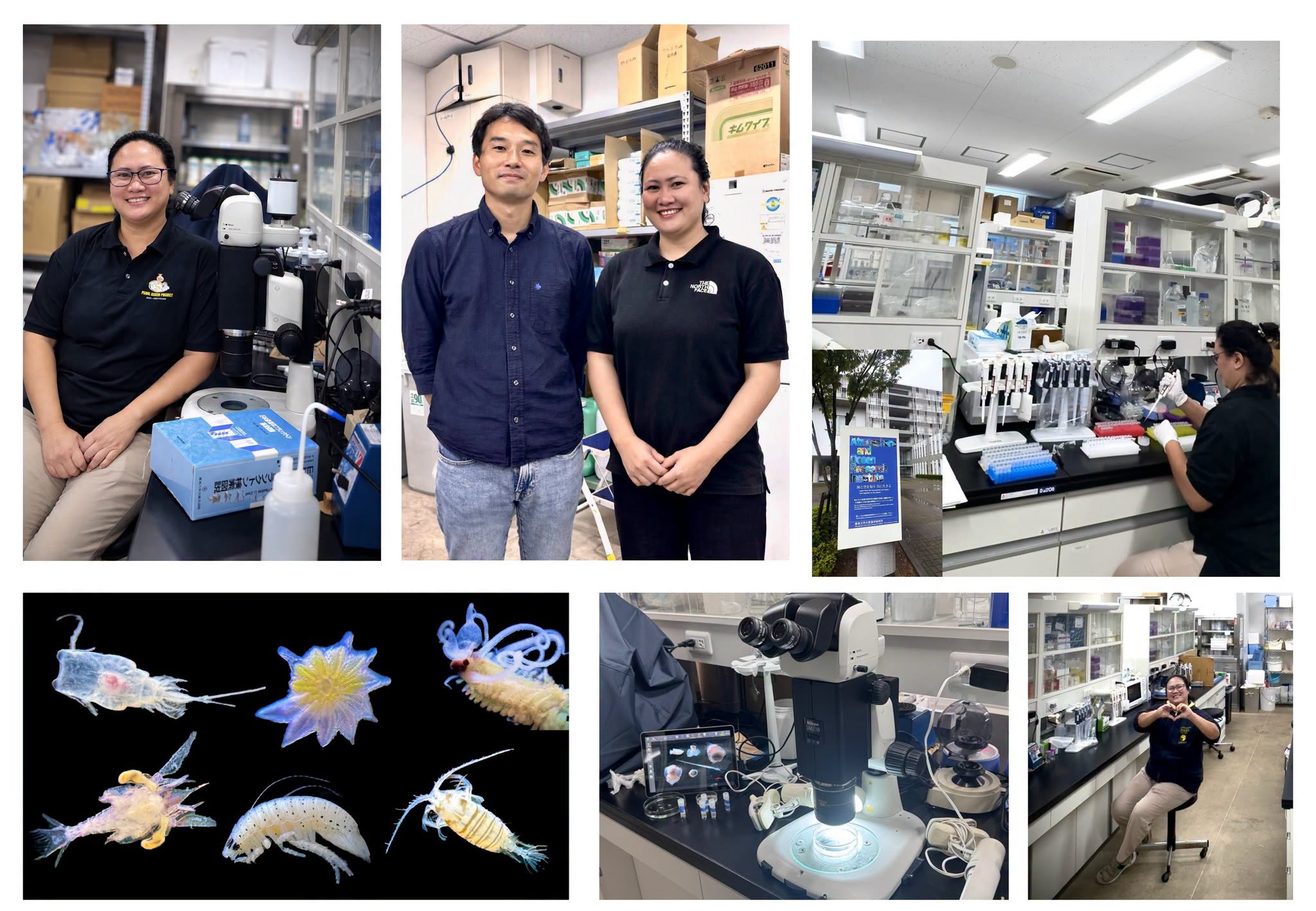
From zooplankton collected in the West Philippine Sea to DNA work inside a University of Tokyo laboratory, marine research from Iloilo State University of Fisheries Science and Technology (ISUFST) is finding its way into a wider scientific community.
Dr. Mary Mar Noblezada-Payne, Associate Professor of the College of Fisheries and Aquatic Sciences (CFAS), completed a two-week research residency at the Atmosphere and Ocean Research Institute (AORI), University of Tokyo, Japan, from September 15 to 29, 2026.
Hosted by Dr. Junya Hirai, Noblezada-Payne served as a visiting scientist, working on marine biodiversity research closely connected with projects already underway at ISUFST. More than a faculty visit abroad, the residency was an opportunity to sharpen laboratory methods, work alongside an international researcher, and explore future research collaboration and mobility.
PHILIPPINE SAMPLES IN A TOKYO LABORATORY
Noblezada-Payne is principal investigator of the ISUFST–DOST-PCAARRD Biodiversity and Molecular Laboratory (BML) and project leader of the ISUFST–DOST-PCAARRD Pearl Genes Project.
Part of her work in Tokyo directly supported the Pearl Genes Project. This included optimizing CO1-specific primers for Pinctada and other commercially important bivalves and applying single nucleotide polymorphisms (SNPs) for high-resolution population genetics.
She also analyzed zooplankton samples from the West Philippine Sea using both morphological and molecular approaches. Her laboratory work included DNA extraction, PCR benchwork, microscopy, and high-precision imaging.
The residency likewise allowed her to refine analysis pipelines and examine protocols and standard operating procedures that could strengthen work at ISUFST’s Biodiversity and Molecular Laboratory.
For the University, that is an important part of the story. What is learned in Tokyo does not have to stay in Tokyo. Better methods and laboratory practices can find their way back to ISUFST’s researchers, students, and ongoing projects.
WHY THE OCEAN WORK MATTERS
The setting was especially fitting for a researcher from a university whose history is closely tied to fisheries and aquatic sciences.
Oceans cover about 70 percent of the planet, yet much of marine life remains unknown. They also interact with the atmosphere and land in shaping climate, making ocean research important not only to biodiversity but also to understanding environmental change.
AORI works across these interconnected fields, from climate and ocean circulation to marine ecosystems, genomics, biodiversity, and the ecology and evolution of marine organisms. It has also played a role in international zooplankton and marine biodiversity research, making the institute particularly relevant to Noblezada-Payne’s work.
INTERNATIONALIZATION THAT REACHES THE LABORATORY
For ISUFST, the residency also offers a practical picture of internationalization.
International partnerships are often seen through agreements, conferences, and official visits. Here, internationalization reached the laboratory bench: an ISUFST scientist working with a counterpart abroad, Philippine marine samples undergoing advanced analysis, and research questions from home becoming part of a wider scientific conversation.
The engagement also explored possible joint research and researcher mobility, opening room for future collaborations that could involve more ISUFST researchers and, eventually, students.
The exchange was not one-way either. Noblezada-Payne brought Philippine samples and research concerns into an international laboratory. ISUFST was not simply receiving knowledge; it was bringing something of its own to the table.
A GOOD SEASON FOR ISUFST FISHERIES
The Tokyo residency comes at an encouraging time for the ISUFST fisheries community. In 2026 Fisheries Professionals Licensure Examination released today, October 6, the University ranked third among the country’s top-performing schools, with 45 of 52 examinees passing for an 86.54-percent passing rate. CFAS graduate Brent Terucha Samontanes also tied for ninth place nationwide with an 87.50-percent rating.
The board results and the Tokyo residency are different achievements, but together they show two sides of the same CFAS story: preparing graduates for the profession while steadily building a research culture that can engage with scientists beyond the country.
LOCAL ROOTS, WIDER WATERS
For a university that grew from the former Iloilo State College of Fisheries, there is something fitting about this direction. ISUFST’s internationalization need not take it away from its roots. It can instead take those roots farther.
Noblezada-Payne’s residency shows how that can happen: bring questions from Philippine waters into laboratories abroad, learn from scientists working in other parts of the world, and bring that experience home to strengthen research, teaching, and future collaborations.
From the West Philippine Sea to the University of Tokyo, the journey of those marine samples may be a small part of a much larger research effort. But it says something important about where ISUFST fisheries science is heading—deeply rooted at home, but increasingly connected to the world. (PAMMCO)
#isufstisdafirst #isufst #isufstcommunity #pammcostoriesthatmatter