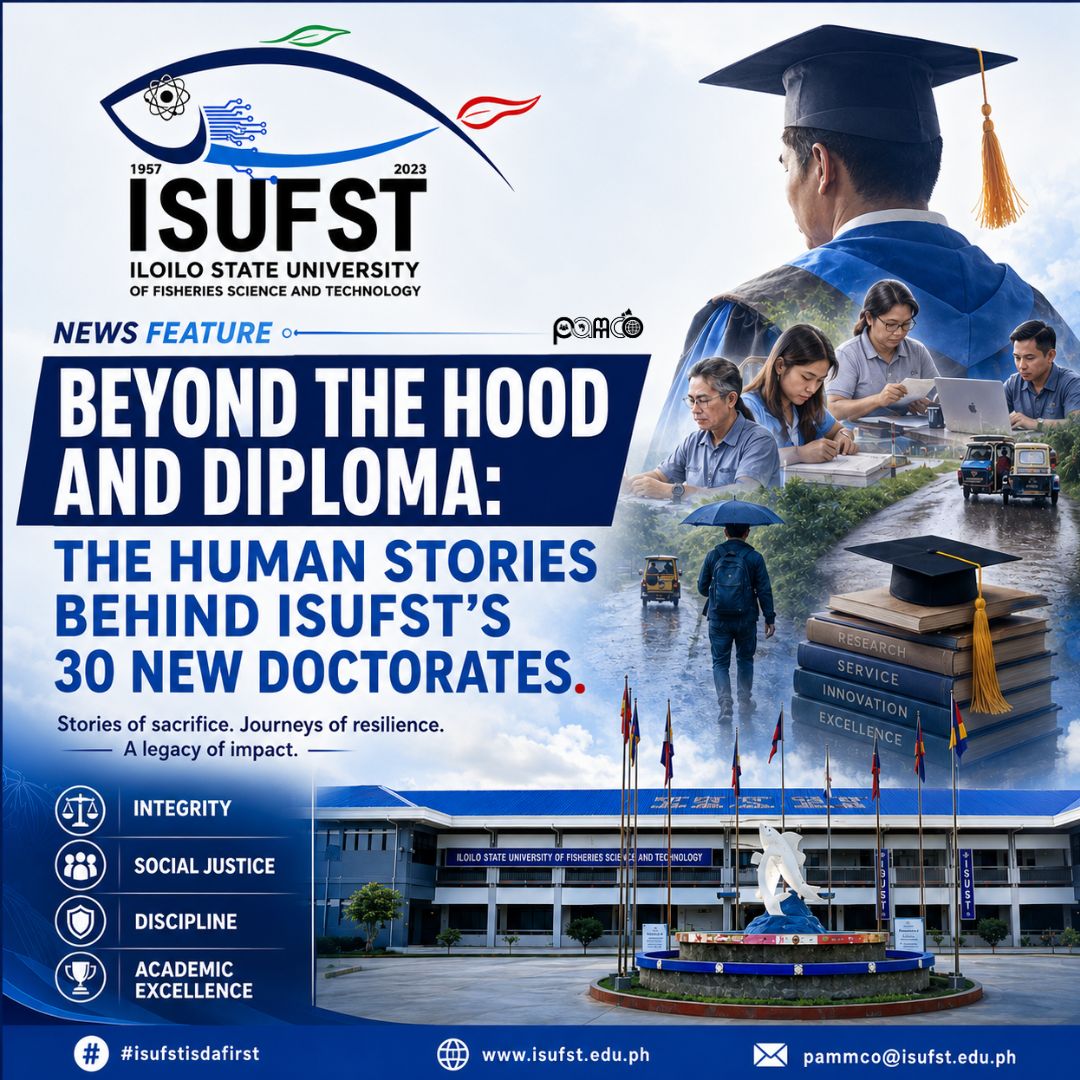
BAROTAC NUEVO, Iloilo — Before the medals, graduation photos, and congratulatory posts, there were sleepless nights no one saw.
There were faculty members revising dissertations after long days of teaching. There were weekend trips taken instead of family rest days. There were flooded roads crossed before sunrise just to avoid missing a morning class. There were moments of burnout, doubt, financial pressure, and quiet prayers offered in silence.
This year, 29 faculty members and one staff member of ISUFST are preparing to complete their doctoral degrees, a milestone shaped by years of sacrifice, perseverance, and belief in education’s power to transform lives.
Across all five campuses, the stories behind the doctoral hoods speak louder than the titles themselves. They reveal educators who kept showing up, for students, for family, for community, and for dreams that often felt distant and exhausting.
“The journey was not linear,” shared Angie Almarza of the Main Campus–Poblacion Site. “It involved challenges, revisions, and continuous learning.” Yet despite the difficulties, she said ISUFST provided “a structured yet flexible ecosystem that fostered resilience, critical thinking, and innovation.”
For many, the doctorate journey unfolded while carrying multiple responsibilities inside the university.
John Rey Alipe balanced doctoral studies while serving as Research Coordinator and BSIT Program Chair. “ISUFST wasn’t just my workplace,” he reflected. “It was a supportive community that pushed me to keep growing.” He added that applying what he learned directly to leadership work made “all the late nights and hard work feel purposeful.”
Others carried even heavier emotional and physical burdens.
April Joy Acosta of the Dingle Campus recalled leaving home early and traveling nearly two and a half hours just to avoid being absent from her 7:30 a.m. class in Roxas City. Many evenings, she arrived home soaked from heavy rain and flooded roads. “These experiences were exhausting,” she admitted, “yet they became powerful reminders of the commitment I had made to myself.”
For Ralph Gerald Bermejo, the journey demanded balancing three identities at once: instructor, doctoral student, and family man.
“Each role demanded time, focus, and commitment,” he said. Yet even amid the pressure, he found strength in the support of colleagues and university leaders who helped lighten the burden during the dissertation stage.
Behind many of the stories was one recurring realization: ISUFST had become more than simply an institution.
“To me, ISUFST was never just a place where I went to work,” shared Roslyn May Paclejan. “It was a true home.” She described the university as more than a workplace — a place that shaped not only her career, but also her values, resilience, humility, and compassion.
That same sentiment echoed across many stories.
John Catunao, who completed a second doctorate in Filipino Language Teaching after earlier earning a PhD in Educational Management, spoke warmly about the people who helped him keep going through the journey. He credited President Dr. Nordy D. Siason Jr., campus administrators, deans, and fellow teachers for helping him persist during the most difficult moments.
“These people remind me that ISUFST is not just an institution,” he said. “It is a true community that genuinely looks after its own.”
Several faculty members also emphasized how institutional support became the bridge between nearly giving up and eventually finishing.
Many cited dissertation subsidies, CHED SIKAP scholarships, teaching deloading, official travel authority, and financial assistance programs that eased the burden of doctoral work. Others said moral encouragement mattered just as much as funding.
“The University did not just give me a job,” Catunao reflected. “It supported my journey every step of the way.”
For some, the doctorate journey permanently reshaped how they now see teaching itself.
“I no longer see my role as limited to delivering instruction,” one faculty member shared. Others described becoming more reflective researchers, more patient mentors, and more community-oriented educators after experiencing firsthand the pressures their own students often face.
Ramir Torreces explained that the experience deepened his understanding that teaching “goes beyond classroom instruction” and now includes research, leadership, extension work, and mentoring.
Meanwhile, Michle Celeste described how her dissertation evolved into something larger because of ISUFST’s research culture. Rather than producing a purely academic output, she developed documentary-based educational materials connected to fisheries and coastal communities.
“Finishing this degree felt like more than a personal achievement,” she shared. “It was a contribution to the goals that ISUFST stands for.”
According to ISUFST President Dr. Nordy D. Siason Jr., the growing number of doctorate holders reflects the university’s investment in people who will shape future communities through education.
He emphasized the importance of developing faculty members who can produce graduates that are competent, socially aware, and values-oriented.
The milestone also echoes the goals of CHED’s A.C.H.I.E.V.E. Agenda 2030 and Sustainable Development Goal 4 on quality education and lifelong learning.
Yet behind all these institutional goals are stories of sacrifice, resilience, and ordinary people simply trying to become better educators.
Some of these educators studied while raising families. Some worried about tuition and transportation. Some traveled long distances every weekend. Some balanced extension work, administration, research, and teaching all at once. Some nearly stopped.
Yet they kept going.
And perhaps that is what makes this milestone quietly inspiring. Behind every doctorate hood this year is not simply academic excellence, but endurance — the kind built slowly through sacrifice, discipline, faith, and people who chose to believe in one another.
In many ways, these 30 new doctorates are not just personal victories. They are reminders that education, at its best, is still an act of hope. (Herman Lagon | PAMMCO)
***
Graduating Doctorates of ISUFST for 2026
San Enrique Campus – College of Education (COED)
1. Jayson C. Palma — Doctor of Philosophy in Science Education major in Mathematics
2. Michael B. Dizon — Doctor of Education major in Science Education
3. Isabel F. Biana — Doctor of Education major in Mathematics Education
4. Zyra E. Gregorio — Doctor of Education major in Mathematics Education
5. Jerlie Mae L. Panes — Doctor of Education major in Filipino Language Teaching
6. Kenth Mark A. Salcedo — Doctor of Education major in Social Science Education
7. Rodelyn P. Padios — Doctor of Management major in Business Administration
8. Roselyn P. Paclejan — Doctor of Management major in Business Administration
Main Campus – Poblacion Site
9. Ralph Gerald M. Bermejo — Doctor in Hospitality Management
10. Ma. Charlene Mae B. Gallo — Doctor in Management in Business Administration
11. John Rey Alipe — Doctor in Information Technology (Artificial Intelligence)
12. Angie Almarza — Doctor in Information Technology (Natural Language Processing)
13. Joanna Marie S. Sabid — Doctor of Education major in Physical Education
14. Liezl A. Dula-ogon — Doctor of Education major in Science Education
15. Kristine M. Hofileña — Doctor of Education major in Physical Education
Dumangas Campus – College of Hospitality Management (CHM)
16. Alfredo A. Gambala — Doctor of Management major in Tourism and Hospitality Management
17. Norlyn Jane B. Valera — Doctor of Management major in Tourism and Hospitality Management
Main Campus – Tiwi Site – College of Education (COED)
18. Christine M. Deocampo — Doctor of Philosophy in Instructional Leadership and Education major in Social Science
19. Frietzie S. Inayan — Doctor of Education major in Physical Education
20. Jezreel C. Donguila — Doctor of Education major in Physical Education
21. Ramir C. Torreces — Doctor of Education major in English Language Teaching
22. Michle M. Celeste — Doctor of Education in Filipino Language Teaching
23. Jomel B. Guintivano — Doctor in Education major in Curriculum Development
24. Clariesol F. Belo — Doctor of Education major in Physical Education
Dingle Campus – College of Education (COED)
25. April Joy D. Acosta — Doctor of Education major in English Language Teaching
26. John D. Catunao — Doctor of Education major in Filipino Language Teaching
27. Soceline N. Batisla-ong — Doctor of Education in Curriculum and Instruction
28. Febe Jane I. Sales — Doctor of Philosophy in Education major in Psychology and Guidance
29. Giefred Ian P. Paniza — Doctor of Education major in Social Science Education
Administrative Staff
30. Emely D. Armonidad — Doctor of Education major in English Language Teaching (EdD-ELT)
(Herman Lagon | PAMMCO)