Just after daybreak, Banate Bay begins to stir.
Fishing boats pull from the shore as the first rays of sunlight extend across the lake. Children run barefoot down the seaside chasing each other, mothers are sweeping yards outside their homes and sellers are getting ready for another day of normalcy. The bay appears tranquil at first sight, little modified through time. But with every tide that rolls back in, comes a quieter story, not only of seawater, but of discarded plastic, of abandoned fishing gear and people’s everyday choices made without thinking too much about where their garbage ultimately goes.
For populations who have lived on the bay for generations, these are not faraway environmental issues debated in conferences or schools. They are part of the day to day. Stuck plastic in the mangrove roots; streams congested with rubbish after heavy rains; diminishing fish catches and coasts that don’t look like the way they used to, are now common sights. The bay that has fed people and sustained livelihoods for generations has begun to feel the weight of human neglect, slowly.
Dr. Johnny B. Dolor has seen that slow change happen over the years.
A faculty member of the College of Education of the Iloilo State University of Fisheries Science and Technology (ISUFST) and now Campus Coordinator of the Main Campus–Poblacion Site, Dolor did not arrive in these communities as someone carrying ready-made answers. First, he arrived as an environmental science instructor who spent time in the coastal communities, listening to residents and seeing how tightly their lives were related to the status of Banate Bay. The more he was there, the more he realized that protecting the bay would take a lot more than sporadic clean ups.
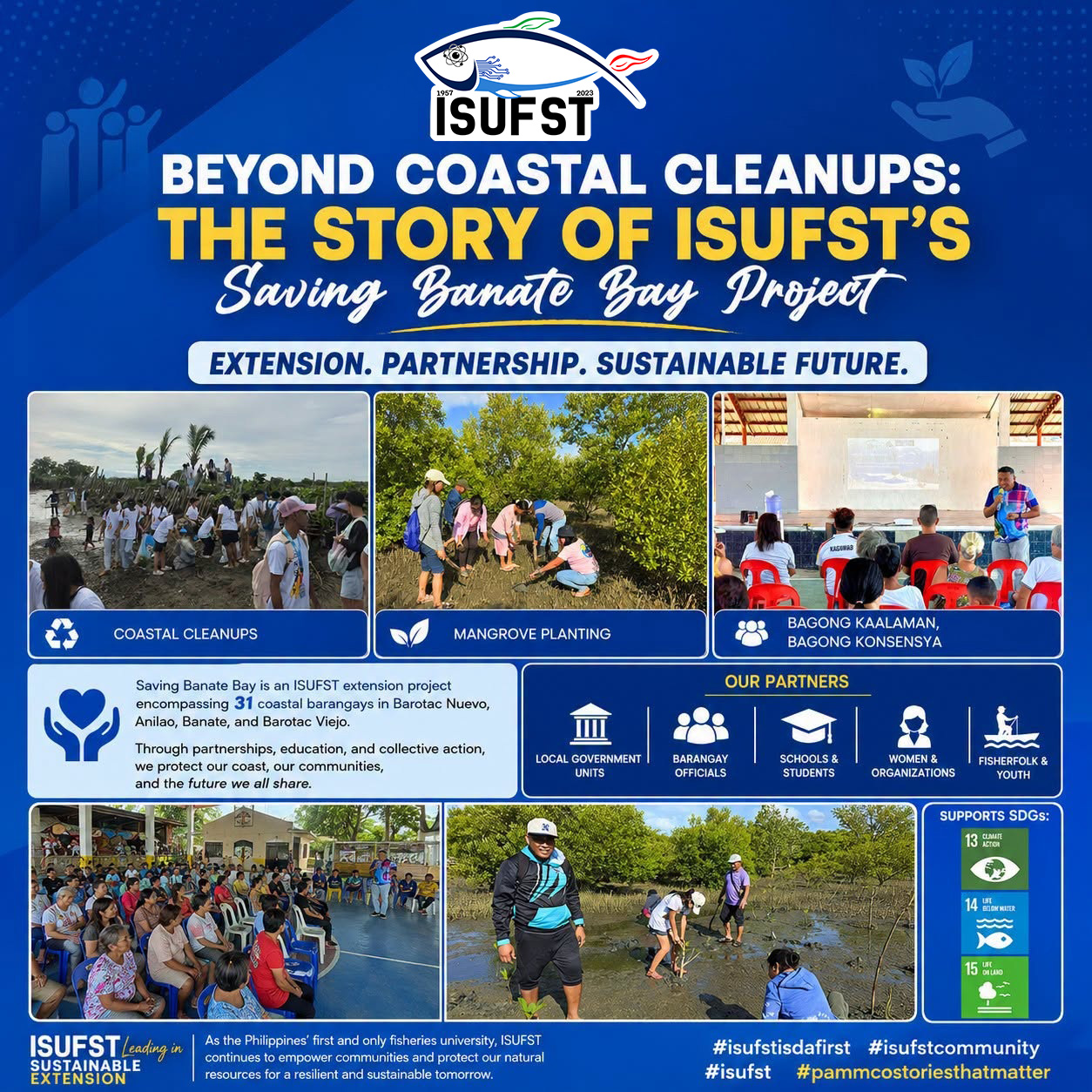
That understanding ultimately blossomed into Saving Banate Bay: An Extension Project for Sustainable Protection of Coastal Ecosystems and Communities, an ISUFST extension project presently encompassing thirty-one coastal barangays in Barotac Nuevo, Anilao, Banate, and Barotac Viejo. It is a project for solid waste management and coastline conservation. Indeed, it is a narrative of individuals learning to care again for a land which has silently cared for them all their lives.
What began as one faculty member’s advocacy soon became a shared commitment of the University. Guided by ISUFST’s Extension and Development Services Office and strengthened by the support of university leaders, faculty members, extension personnel, and student volunteers, the initiative gradually grew into a partnership with local governments and coastal communities. Together, they transformed classroom knowledge into action along the shores of Banate Bay.
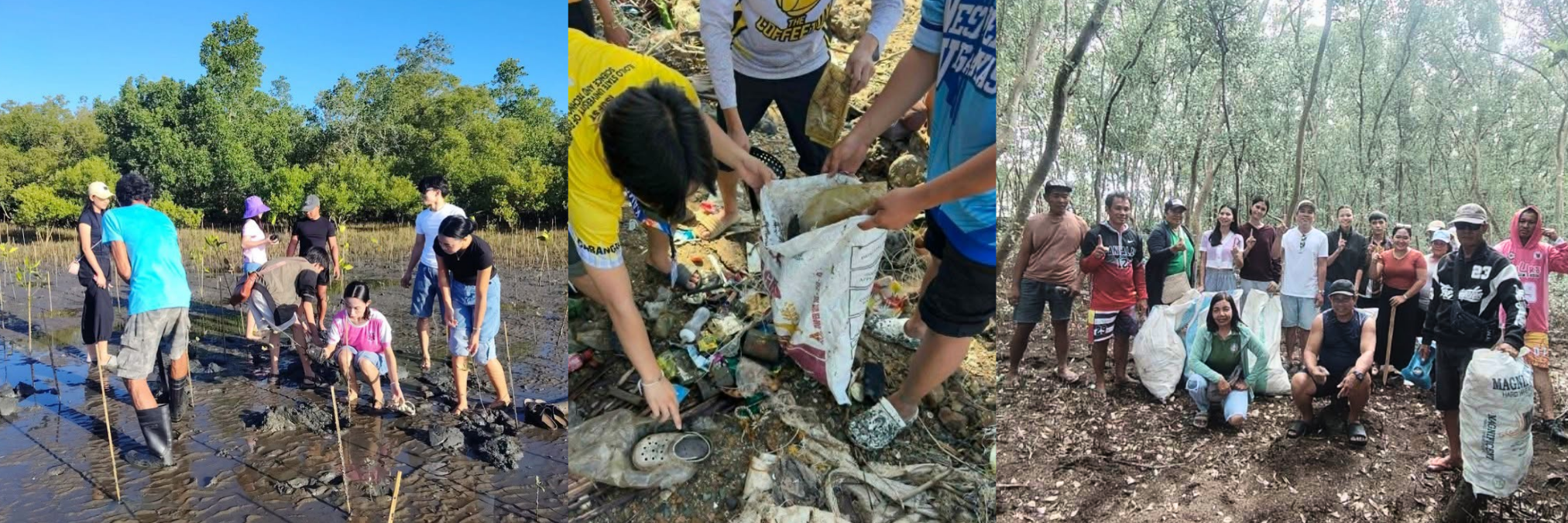
It wasn’t from a planning workshop or a boardroom. It emerged slowly, via years of coastal cleanups, mangrove planting, classroom debates and talks with fisherfolk who knew the bay better than any textbook. Dolor watched plastic pollution spread through mangrove areas. He saw communities becoming more vulnerable as environmental problems accumulated. Rather than asking why people were not doing enough, he began asking what ISUFST, as the country’s first and only fisheries university, could meaningfully contribute.
The answer was not another one-day environmental campaign.
Instead, ISUFST and Dolor chose to build partnerships with the very communities whose lives are inseparable from Banate Bay. The 31 barangays became more than project sites; they became collaborators. Local government units, barangay officials, schools, community organizations, students, women, fisherfolk, and youth volunteers each brought something different to the table. Protecting the bay would not succeed if only one sector carried the responsibility.
TEACHING BEFORE CLEANING
Many environmental projects begin by handing people gloves and garbage bags.
This one began by asking people to sit down and talk.
There were the Pulong-Pulong sa Barangay meetings, before the coastal clean-ups, before the mangrove planting, before the pictures of the bags of gathered rubbish. Residents talked of the storms they had weathered, the changes in fishing areas over the years, home customs, and the simple facts of life beside the water. The ISUFST extension team came prepared to share ideas, but they quickly realized that listening was just as important. Faculty members, extension staff, and student volunteers learned alongside the communities, discovering that meaningful extension work begins with understanding people’s lives before offering solutions.
Over time, those interactions changed the tone of the project. It was no longer about reminding individuals what they were doing wrong . It was a call to picture what their communities might look like if everyone were involved.
Dolor admits that this part of the work tested his patience more than any cleanup activity ever could.
“There were times when some people actively participated while others seemed completely uninterested,” he recalled. “But I always told myself that this should not stop me. Eventually, time will come that they will engage themselves.” That quiet resolve kept him returning to the communities even on days when progress felt almost invisible.
He found that changing habits is seldom achieved just through lectures. People don’t give up years of routine in one seminar. They adapt after talking over and over, after watching neighbors behave differently, after recognizing that the convenience of today’s life could be the difficulty for their own children tomorrow.
And that is why the initiative always reverted to one idea, the ideas of the circular economy. Waste should not just vanish from sight but should be carefully managed before it becomes pollution. Every discarded bottle, plastic wrapper or torn fishing net has to end up somewhere. Most times, it ends up back in the same sea that nourishes the community.
Slowly, the conversations began to turn from waste to accountability.
As residents who earlier thought that trash management was the government’s responsibility began to realize their own responsibilities in maintaining Banate Bay. The project never asked for perfection. It was just the next little step—sorting rubbish, taking part in a cleanup, planting a mangrove, going to a barangay meeting, reminding a neighbor. None of these things was extraordinary in itself. But, together, they started to change the way people looked at the bay—and themselves.
WHEN COMMUNITIES PARTNER
It didn’t take the project team long to recognize that the most important changes would never be assessed by the number of seminars given or the amount of garbage collected. Those numbers counted, but only conveyed part of the story. The bigger concern was if people would still care about Banate Bay once the university packed up its tarps, its equipment and headed back to campus. That answer came slowly—and frequently when no one was looking for it.
One afternoon, after months of community activities, Dolor got an invitation from a barangay he had visited many times before. This time, though, he was not being asked to provide another orientation or lead another discussion. The barangay officials simply wanted him to see what they had done. They had strengthened their garbage collection system, improved the operation of their Material Recovery Facility, and begun implementing local ordinances aimed at protecting Banate Bay. The initiative was no longer being driven by the university. The community had taken ownership of it.
For Dolor, moments like that are difficult to describe because they rarely make headlines. There is no ribbon-cutting ceremony when a community quietly changes its habits. No applause follows when residents begin segregating waste because they have chosen to, not because someone is watching. Yet these quiet shifts are the ones he values most. They suggest that the conversations have moved beyond awareness and have started shaping the way people live.
“I realized that change does not happen because someone from the university tells people what to do,” he reflected. “It happens when people themselves begin believing that protecting the bay is protecting their own future.” It is a lesson he has carried into every succeeding activity. Extension work, he believes, is not about creating dependence on the university. It is about helping communities discover that they already possess the capacity to solve many of their own problems when given knowledge, encouragement, and the opportunity to work together.
That shared ownership became possible because every sector found its own place in the project. Barangay officials did more than approve activities. They mobilized residents, supported policy development, and reinforced environmental programs long after university visits had ended. Their leadership helped transform what could have remained a series of extension activities into community initiatives with lasting local support.
Women also emerged as some of the project’s quiet but consistent champions. Inside their homes, they encouraged proper waste segregation and responsible household practices. Outside, many joined coastal cleanups and became steady voices reminding neighbors that environmental care begins with everyday routines. Their influence rarely came through speeches. It came through example, repeated day after day, until good practices became familiar to others as well.
The youth brought a different kind of energy. Members of the Sangguniang Kabataan did not see themselves as volunteers simply helping with a university activity. They understood that they would one day inherit whatever kind of Banate Bay today’s generation leaves behind. They found a purpose in participating in clean up initiatives, awareness campaigns and community conversations. In their zeal, they also often encouraged other young residents to join in, and there was a ripple effect beyond the planned project activities.
The project was a more immediate concern for fisherfolk. If your family’s livelihood depends on the water, a polluted bay isn’t some abstract environmental problem. Discussions on abandoned fishing nets, waste in the ocean and microplastics were not just scientific explanations. These were discussions about maintaining fishing grounds, protecting marine life and guaranteeing that future generations might still make a living from the sea. Many became vocal advocates because they recognized that every bit of trash that ends up in the bay eventually comes back — not only to the coastline but also to their nets, their catch, and ultimately their tables.
Meanwhile, ISUFST students found that extension work is considerably different when lectures are no longer confined to classrooms. They joined beach cleanups, conducted Pulong-Pulong sa Barangay, distributed educational materials and spent time listening to residents whose stories could never be appropriately written in textbooks. Many learnt that public service is less about being the one with the answers and more about being willing to learn with others, between bagging picked-up garbage and sharing meals with fellow community members.
Volunteerism, environmental stewardship, and social responsibility stopped being classroom concepts. They became part of everyday life. Guided by their faculty mentors and supported by the University’s Extension office, many students discovered that the most meaningful lessons are often learned far beyond campus walls.
It was not a smooth journey. Because of financial concerns, several plans had to be changed. Activities were stopped by bad weather sometimes. Even more difficult was changing behaviors acquired over many years. People aren’t always ready to embrace new approaches, especially if the old ways seem more convenient. There were times when the progress felt excruciatingly slow. But rather than seeing such challenges as reasons to cease, the project team saw them as part of the community effort itself.
Trust is rarely established in one meeting. It is like mangroves, growing slowly, taking root through patience, consistency, and relationships that are built over time.
Perhaps that is why Saving Banate Bay feels different from a typical environmental campaign. It was never designed to end when the cleanup was over or when the final report had been submitted. Its real success lies in something less visible: communities that have started reminding one another to care for the bay without waiting for the university to tell them what to do. And that may be the strongest sign yet that the project has become exactly what it hoped to be—not simply an ISUFST initiative, but a community story.
Looking back, Dolor is quick to say that the project never belonged to him alone. He credits the steadfast support of ISUFST’s administration, the guidance of the Extension and Development Services Office, fellow faculty members and staff who worked behind the scenes, students who willingly volunteered their time, partner local government units, and the thirty-one coastal barangays that welcomed the University into their communities. Their shared commitment, he said, turned a simple idea into a lasting partnership.
A UNIVERSITY’S PROMISE BEYOND THE CLASSROOM
By now, there are things the project can count.
There are mangroves planted along stretches of the coastline. There are barangays that have strengthened their Material Recovery Facilities. There are communities that have improved waste segregation and local ordinances that now give stronger support to proper solid waste management. These are tangible outcomes—visible reminders that months of patient work have produced real results.
But if Dolor were asked what makes him smile most when he returns to these communities, he would likely mention something that cannot be placed in a report.
It is seeing residents remind one another not to throw trash into the water. It is watching children join cleanup activities without being told. It is hearing conversations about protecting the bay happen naturally during barangay gatherings. These moments may never appear in accomplishment reports, yet they reveal something far more important. They suggest that caring for Banate Bay is slowly becoming part of everyday life rather than something people do only when a university activity is scheduled.
That was always the intention.
From the beginning, Saving Banate Bay was designed to outlive the University’s calendar of extension activities. ISUFST never intended to become the permanent driver of every cleanup or every environmental campaign. Universities can provide the ideas and technological competence, but it is the communities that make those ideas real. Local leaders, community volunteers, fisherfolk, women’s groups, youth organizations and ordinary people were encouraged to be stewards of the advocacy because they are the ones who would continue living by the bay long after every extended visit has ended.
For Dolor, that shared ownership is perhaps the project’s greatest accomplishment.
“The project is jointly owned by ISUFST and the coastal communities of Banate Bay,” he said. It is a statement that reflects how he sees extension work—not as something the university gives to people, but as something built together with them. Universities can offer knowledge and guidance, but real change begins when communities embrace the work as their own. Without their trust and participation, even the best ideas remain just that—ideas.
The experience changed Dolor, too.
Looking back, Dolor hopes people will remember Saving Banate Bay not simply as an environmental project but as proof of what can happen when a university and its communities choose to work side by side. Through the leadership of ISUFST, the dedication of its Extension Office, the commitment of faculty and staff, the enthusiasm of student volunteers, the support of partner local government units, and the trust of the coastal communities of Banate Bay, what began as a series of cleanups became something much larger—a shared commitment to protect a place generations have called home.
In the end, the project’s greatest achievement may not be the number of mangroves planted or sacks of waste collected. It is the growing belief that caring for Banate Bay is no longer the responsibility of a few, but a shared promise carried by everyone who calls its shores home. That, perhaps, is the quiet legacy of ISUFST’s Saving Banate Bay project. (PAMMCO)